
What Makes a JCC Feel Like a JCC?
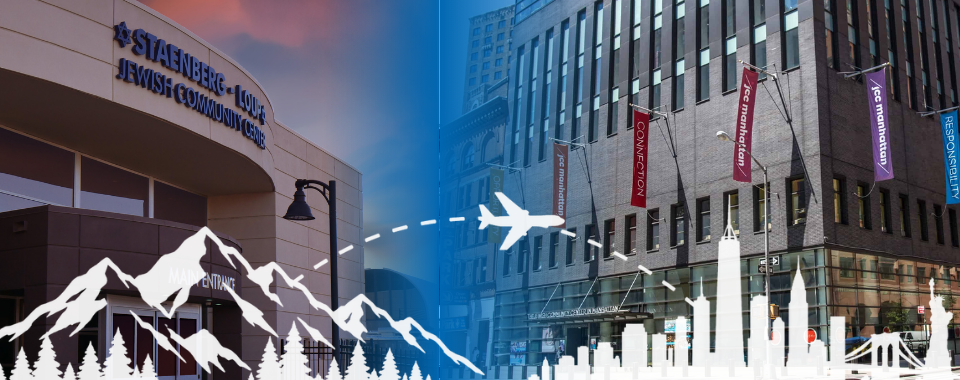
Nearly 1,800 miles separate Denver from Manhattan. One JCC sits in Colorado, with the Rocky Mountains just a drive away, while the other stretches 14 stories above New York City’s Upper West Side. They have different logos, different programs, and communities shaped by entirely different cities.
And yet, walking through the doors of the Marlene Meyerson JCC Manhattan, something felt surprisingly familiar.
I visited the Manhattan J with a question in mind: What actually connects JCC Denver to a JCC nearly 2,000 miles away, or to any of the JCCs (aka “the J”) serving communities across North America?
The answer, I quickly realized, wasn’t how closely our buildings or programs resembled one another. It was found in the people who filled those spaces.
Deb Kadetsky, Chief Engagement Officer at the Marlene Meyerson JCC Manhattan, shared that their community often refers to the J as a “third space” or “second home.”
“We’re not work. We’re not home. We are a place where they can be in community,” she said.
For those of us at JCC Denver, that idea feels familiar. We often talk about the J as being at the heart of our community, but that heart is made up of countless individual moments.
In Manhattan, many of those moments happen vertically. Some of Kadetsky’s favorite examples of community happen in one of the building’s most ordinary spaces: the elevator.
“There’s somebody coming from the gym, somebody coming from, I don’t know, a card game, and somebody who is just taking a tour for the first time,” she said. “All ages and stages show up.”
A community center can be a destination without requiring a particular reason for being there. Someone might arrive for a class and stay for a conversation. A parent might linger after drop-off. A person coming in alone might encounter someone they know. Over time, those ordinary interactions create familiarity, and familiarity can become belonging.
That is part of what makes the idea of a “third space” so powerful. A JCC does not have to be just the place where someone swims, takes a class, or attends an event. It can become part of the rhythm of a person’s life, a place where simply showing up means being around other people.


For Barak Hermann, president and CEO of JCC Association of North America, that feeling is recognizable far beyond Denver or Manhattan.
“I’ve walked into JCCs in major metro areas, smaller cities, and in small towns, and what strikes me every time is that the feeling is the same: this is a Jewish communal home,” Hermann said.
“Every JCC looks a little different, because every community it serves is different, and that’s exactly as it should be,” Hermann said. “But underneath that variation, JCCs share the same core purpose: creating welcoming spaces where Jewish life is lived, celebrated, and passed down to the next generation, and where Jewish and non-Jewish neighbors alike can find belonging.”
That idea reflects something recognizable across the JCC Movement. Each J is shaped by the community it serves, responding to the needs, character, and culture of the place it calls home. The result is not a collection of identical organizations, but individual communities connected by a familiar purpose.
There is also something pretty remarkable about realizing just how far that community stretches. Today, the JCC Movement includes 150 JCCs and JCC camps across North America, with 1.5 million people engaging with a JCC each week. Across the Movement, 35,000 professionals work within early childhood centers, summer camps, arts and culture programs, senior adult programs, fitness and wellness spaces, social services, and countless other community offerings.
The Manhattan J is unmistakably Manhattan. JCC Denver is unmistakably Denver. That distinction is not something to overcome. It is part of what makes the larger network of JCCs so meaningful.
Through the JCC Association, individual Js have opportunities to exchange ideas, learn from one another, and bring their own experiences into a much larger conversation. Kadetsky described Manhattan’s participation as a chance to contribute thought leadership while also learning how other JCCs are “leveraging their voice.”
Hermann describes that connection from a Movement-wide perspective.
“What’s most meaningful to me is knowing that no JCC is doing this work alone,” he said. “They’re all part of the same story.”
Whether community is being built inside an elevator, across a preschool classroom, during a workout, at a performance, around a Shabbat table, or simply over a cup of coffee, the purpose remains remarkably familiar.
Maybe that is what makes a JCC feel like a JCC.
JCC Denver Reciprocal Guest Pass Policy
JCC Denver offers eligible members of other JCCs a reciprocal guest pass for up to five days, subject to membership verification and approval.
Advance notification: Guests should contact the JCC Denver Membership Department before their visit and provide their home JCC and intended visit dates. Alternatively, the guest’s home JCC may contact JCC Denver directly to confirm the guest’s name and membership in good standing.
Membership verification: The JCC Denver Membership Department will verify that the guest holds an active membership in good standing at their home JCC.
Approval and entry instructions: Once eligibility is confirmed, the Membership Department will contact the guest to approve the reciprocal guest pass and explain the check-in and entry process.
Pass issuance and validity: Upon arrival, the guest will receive a reciprocal guest pass valid only for the approved visit dates, for a maximum of five days.
Additional visits: Guests wishing to visit beyond the five-day reciprocal period must purchase a daily guest pass for each additional day.
Reciprocal guest policies vary by JCC, and some JCCs do not offer reciprocal access. Guests planning to visit another JCC should contact that location directly to confirm its policy.